Tag Archive | family

In the matter of the People Vs. Monkey

Kid2: …so that’s why Ariadne* was so upset.

Defense Attorney: But it was never your intention to hurt her feelings?

Kid2: No! I didn’t want to hurt anyone’s feelings!

Defense Attorney: Can you explain to the court again, step by step, the events that led up to Ariadne’s time-out?

Kid2: Okay, so…I told Ariadne I would do the hundred board with her. But then Artemis…wait. I’ll draw it for you.

Continue reading

Does wearing makeup make me a bad feminist parent?

I’ve been seeing this post about a daughter’s questions about her mom’s makeup in my news feed recently, and it’s made me think. Christine Burke describes how her daughter’s simple question made her see herself through a 7 year-old’s eyes and examine why she spent so much time and effort contouring, highlighting, plucking, cleansing, and otherwise enhancing her looks.

Does wearing makeup make me a bad feminist - karyn in prom makeup www.picklesink.com

Does wearing makeup make me a bad feminist?

Continue reading

A Passion For Compassion

In one of my university social work class there was an intense argument about nature versus nurture – Is empathy innate or learned? As I recall, I took the innate side of the argument then but I’ve since changed my tune. I believe that empathy can and should be taught starting at a young age.

The Oxford Dictionary defines empathy as, “the ability to understand and share the feelings of another,” and Wikipedia notes, “One may need to have a certain amount of empathy before being able to experience compassion.” I think of empathy as the ability to recognize how another person feels and compassion as the drive help them feel better. Both empathy and compassion have been important parts of my life and I feel that they are two of the most crucial interpersonal skills I can pass on to my children.

Learning compassion young - baby and disabled woman smile at each other

Kid1 and Carol grin at each other. Carol was my nanny when I was young. She was disabled by a brain aneurysm and is mostly non-verbal, but she can still make her feelings known!

Continue reading

Minutes of the Pickles Family Meeting Regarding…well, I’m not exactly sure.

Pickles Family Meeting

January 26, 2015

Agenda

1.0 Money and math

2.0 Other business

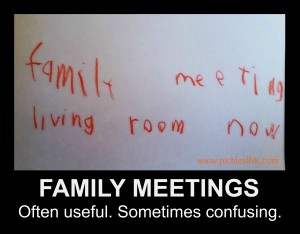
Regular family meetings are a very useful parenting strategy, but sometimes when your child takes the reins they can get a little...confusing. www.picklesINK.com

Family meetings: Often useful. Sometimes confusing.

Minutes

Kid1 called the meeting to order at 7:01 pm.

Kid1 asked Kid2 to put her dolls away. Kid2 declined with extreme prejudice.

Continue reading

7 Reasons Why This School is Banning Halloween

Here’s one for the “What is the world coming to?” files.

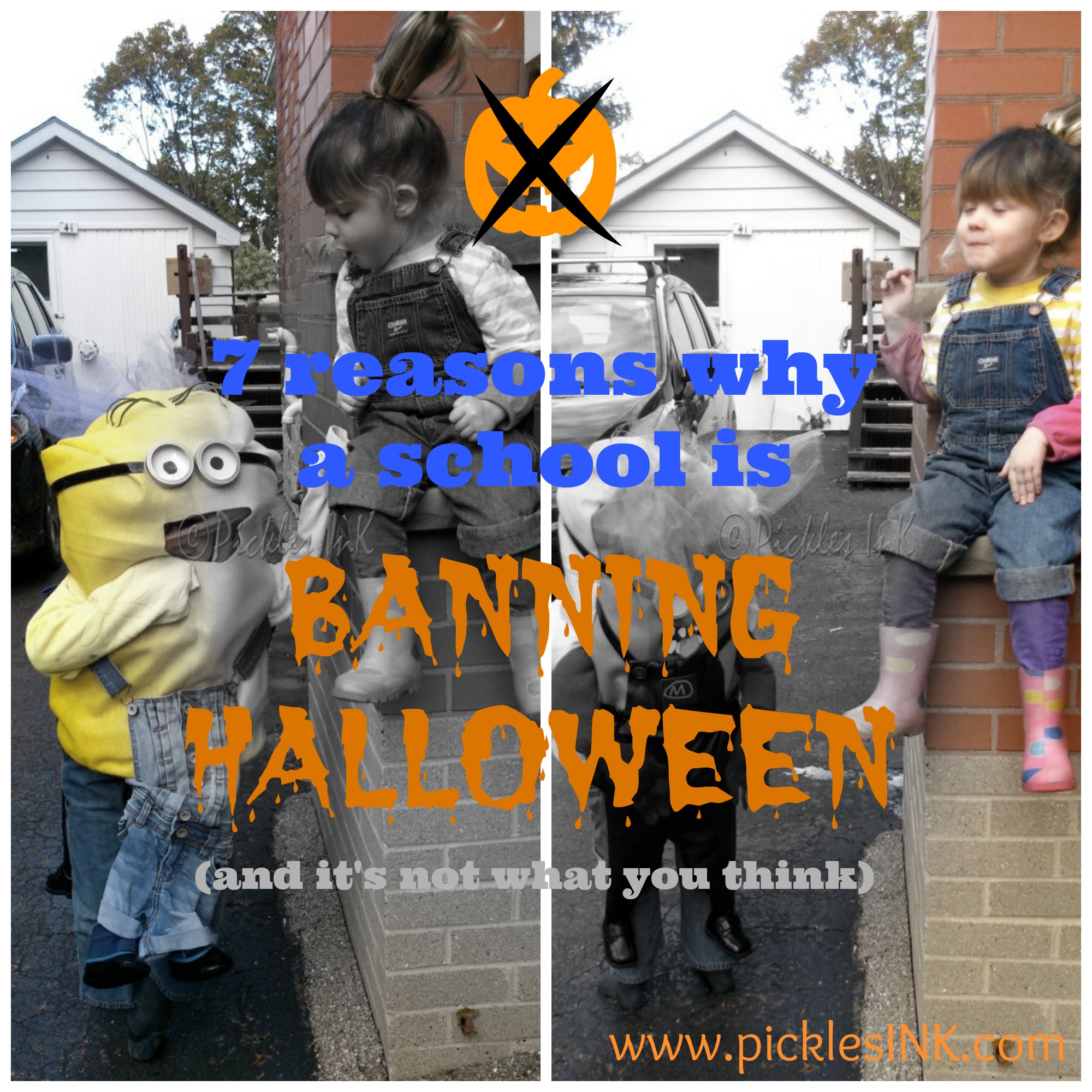
7 reasons why a school is banning Halloween (and it's not what you think)

This gem scrolled through my Facebook feed yesterday: A friend’s children’s school has decided to forgo Halloween this year in favour of…I don’t know…Friday, I guess. The decision was attributed to the “staff” and the reasons behind it were given as follows: Continue reading

Who’s really sexualizing our daughters, anyway?

The fabulous Stephanie Giese of Binkies and Briefcases wrote a viral post about her disbelief at the sizing and coverage in Target’s clothing options for young girls. She had been noticing what seemed to be a distinct reluctance to include…y’know…fabric…in items like shorts for girls as young as 5. Her post received a mostly positive response, but also a fair bit of backlash (One standout was a commenter who posited that she should put her “fat-ass kid” on a diet if she wanted clothes to fit her better. Way to keep it classy, interweb.).

Quite impressively, Target reacted almost immediately, reaching out to her, doing their own research, and promising an overhaul of their sizing practices including feedback from “real” moms like her, which is awesome – we should be able to find clothing for our children that fit with our own tastes and values without having to pull out our sewing machines and make or modify them ourselves.

But…(you know me…there’s got to be a but)…I don’t agree with the reasoning that we need more modest clothing options to avoid sexualizing our young daughters. Children are not sexual. Exposed skin is not sexual. Children with exposed skin are not sexual.

Children are children. Continue reading

Stranger Danger

We had a child luring attempt in our small town recently, which is of course terrifying. I haven’t done much talking to Kids 1 and 2 so far about stranger danger, for a number of reasons.

Kid1 has a tendency to be very anxious. Last year one of his school friends told him about “strangers” and he went into an anxiety tailspin for days. Often once he starts thinking about something scary he’ll continue to worry about it no matter how remote or even completely impossible the threat is:

Kid1: “I looked at that picture in my bug book and now I’m afraid of scorpions.”

Me: “There are no scorpions in Canada.”

Kid1: “I know. But I’m still scared that one will sting me.”

Me: “But there aren’t any in Canada. You can’t be stung by one.”

Kid1: “I know. But what if I was? They are extremely venomous.”

Me: “There is absolutely no way that you could be stung by a scorpion.”

Kid1: “I know. But I’m still scared. What if I was?”

Me: “Well, you could pretend to be a giant bird that eats scorpions.”

Kid1: “Okay!       …Wait, now I’m scared of the giant bird.”

Me: *headdesk*

Statistics show that “stranger danger” is blown way out of proportion. The best and most recent estimate found that 25 children of the 46,718 reported missing in 2011 were listed as “abducted by stranger” — but “stranger” was defined as anyone who was not a parent, including relatives, family friends, or babysitters as well as the eponymous “stranger.” A 2003 study by the RCMP’s National Missing Children Services studied the 90 stranger abduction missing child reports entered into the national police database in 2000 and 2001 and found that only 2 of those children had been abducted by someone other than a relative or a close family friend.

Finally, up until last summer Kid1 wouldn’t have been anywhere unsupervised where a “stranger” could approach him anyway.

But my little baby boy is growing older, moving outside of my helicopter mommy bubble, spending time playing outside with friends, and even getting ready to walk to the bus stop by himself next year (all of which feels completely, utterly ridiculous to me before I remember that at his age I was walking 4 blocks to the corner store by myself).

So with this incident happening only blocks from our house, The Conversation became a necessity – obviously because the same person could still be in the neighbourhood, but also because I anticipated it being discussed at school (by both the teachers and the other kids), and I wanted Kid1 to hear it from me first so he could ask any questions he had and process the information thoroughly.

First of all – the reality. Stranger are not particularly dangerous. Most strangers are neutral to benign, and many can be quite helpful. You are far more likely to fall victim to a random act of kindness than a kidnapping attempt. The concept of “Stranger Danger” has actually served to distract 3 generations from the statistically greater danger to children – family members, friends, and acquaintances, who are far more likely to abuse, molest, and/or kidnap them than some creepy dude in a van.

Last month’s Today’s Parent Debate was about whether or not you would leave your child alone in the car, and the Facebook post on the topic garnered heated debate.

Much of the “no” side focused on the dangers of leaving your child unattended in a car – and there are certainly dangers to doing so – but a number of the posters were adamant that there was a significant risk that someone walking by would see your children and seize the opportunity to smash a window, get in, “hotwire” the car, and drive away with your children still buckled into their carseats like a beautifully wrapped present.

Scary, sure. Realistic? No. Pedophiles don’t walk around convenience stores and gas stations rubbing their palms together and waiting for an unattended car full of children. Pedophiles befriend their neighbours’ kids. They pay extra-special attention to their nieces. They take vacations to countries where child sex trafficking is rampant. They win the “Coach of the Year Awards”. They insinuate themselves into positions of trust and authority over children, ingratiate themselves to the parents, groom the children for years before they actually start abusing them, and cultivate an atmosphere of secrecy where the children don’t realize anything is wrong until it’s too late and they know that no-one would believe them anyway.

If you want your children to be safe from the boogeymen, you have to teach them what the boogeymen really are. The boogeymen are people who make your children feel uncomfortable. They are grownups who ask children for help and tell children to keep secrets. They could be people you love very much and whom your children love very much, people your child trusts and looks up to, and people you would never dream would do “something like that.”

I therefore decided that rather than focus on “strangers” or “bad guys” I would talk to Kid1 about “grown-ups,” and what grown-ups should and shouldn’t do when it comes to kids.

So this is what I told Kid1:

“Bud, I need to talk to you about something a little bit scary. Remember when your friend told you about strangers, and made you scared about them, and I said that you didn’t need to worry about it? I need to talk to you a little more about strangers now. You know that strangers are just people you haven’t met yet, right? Most – almost all – strangers are not scary at all.

Sometimes people will tell you “never talk to strangers” but that’s not right. If you every get separated from mommy or daddy, you DEFINITELY need to talk to a stranger – good strangers to talk to are people wearing a uniform, or people who work in a store, or a mommy or daddy with kids. Those are all people who will know exactly how to help a lost child get back to his parents. And if you’re with mommy or daddy and a stranger talks to you, it’s polite to answer them, but you don’t have to have a long talk with them if you don’t want to.

Something happened this week in our town – a boy was walking home from school by himself, and a stranger stopped his car and talked to him and asked him to get into his car. That’s not okay. Grown-ups should not talk to kids who are by themselves, and they should definitely not ask kids to come with them.

That doesn’t happen very often at all, and it will probably never, ever happen to you, but just in case it ever does, it’s important to know what to do. This boy stayed safe because he knew exactly what to do – he didn’t answer the stranger and he ran away as fast as he could to a place with lots of people – back to his school – and he told a grown-up there. If a stranger ever talks to you or your friends when you aren’t with a grown-up, you don’t have to be polite. You and your friends run as fast as you can to a place where there are other people and tell a grown-up what happened.

Grown-ups should not talk to kids they don’t know unless there is another grown-up there to make the kids feel safe. Grown-ups should not ask kids for help with anything – they should ask other grown-ups. And grown-ups should not ask kids to keep secrets (surprises are different because they are not going to be kept secrets forever – only until it’s time for the surprise) or to do anything that another grown-up can’t know about.

If a grown-up ever does any of those things, your job is to tell a grown-up that you trust about it right away.”

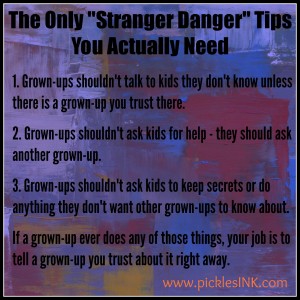
Stranger Danger Tips

Text reads: “The Only “Stranger Danger” Tips You Actually Need” 1. Grown-ups shouldn’t talk to kids they don’t know unless there is a grown-up you trust there. 2. Grown-ups shouldn’t ask kids for help – they should ask another grown-up. 3. Grown-ups shouldn’t ask kids to keep secrets or do anything they don’t want other grown-ups to know about. If a grown-up ever does any of those things, your job is to tell a grown-up you trust about it right away.

Kid2 listened too, and nodded sagely, though I don’t know how much of the conversation she took in. I was happy with the outcome as Kid1 asked questions, gave me the right answers when I quizzed him, and most importantly felt confident and not frightened when we finished the discussion.

~ karyn

Minutes of Pickles Family Meeting Regarding Equitable Distribution of Chocolates

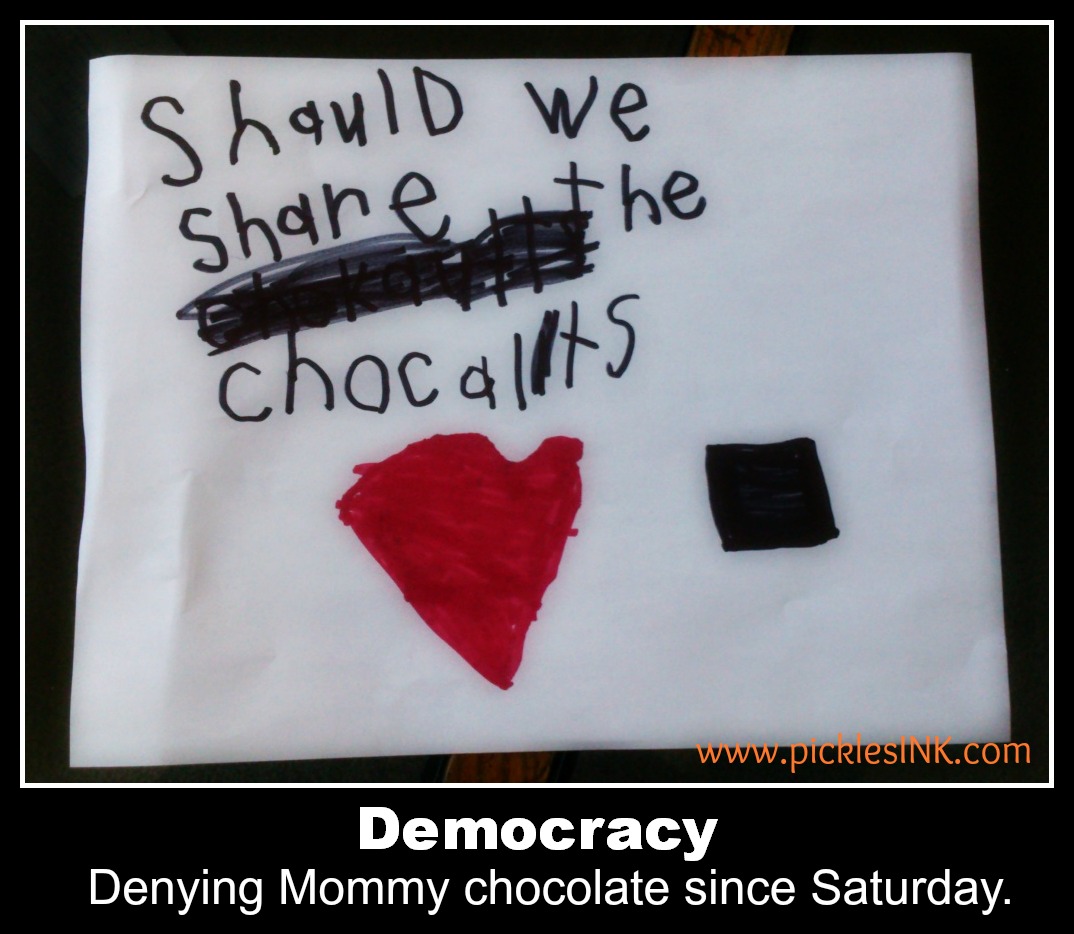
Family meeting sign with caption

Pickles Family Meeting Regarding Equitable Distribution of Chocolates

February 1, 2014

Present: Kid1, Kid2, Mommy, Daddy

Regrets: None

Kid1 called the meeting to order at 6:00 PM.

Kid1 explained that he had called a family meeting to address the issue of Mommy eating more than 11 After Eight chocolates.

Kid1 stated that he feels it is important that we share treats and one person doesn’t eat all of them.

Mommy asked if this applies to Fortnam&Mason apple & custard hard candies as well because when Kid2 was told yesterday that she could only have her apple slices for snack, she sneaked into the cupboard and served herself a bowl of candies and ate them all.

Kid2 countered that she did not in fact eat them all because she could not fit the remainder in her mouth when Mommy came to take them away and that was mean.

Daddy giggled helplessly and unhelpfully.

Kid1 proposed that we require the sharing of chocolates equally and introduce a rule that chocolates only be eaten one at a time.

Mommy clarified that she had in fact eaten the chocolates one at a time, just in rapid succession.

Daddy asked if this directive would apply solely to chocolate or to other candies and/or treats.

Kid1 clarified that he intended the directive to include all candies and/or treats.

Kid1 proposed a vote by secret ballot and handed out ballots which, adding insult to injury, he then collected in the empty After Eight box.

Moved by Kid1 and seconded by Daddy that all candies and/or treats be shared in a fair and equitable manner and not consumed in disproportionate numbers by one person.                                                                                    Carried.

Mommy offered a formal apology: “I’m very sorry I ate so many.”

Kid2 offered no further comment regarding the hard candies.

Meeting adjourned at 6:20 PM.

candies

Unmistakable evidence of Kid2’s candy-eating transgression.

family meeting

Scrutineer tallying the results of the vote.

Other parents’ judgement? That’s the leash-t of my worries.

I love Today’s Parent. I don’t always agree with everything in it, but it’s always a good read, and gosh-dang-it, y’all know I’m a sucker for any kind of child development material!

The topic of this month’s “Debate” column is “Should you use a leash to control your toddler?” and I felt it missed the mark. I was frankly offended by Nadine Silverthorne’s assertion that “parents who use leashes look lazy,” and although Amy Morrison’s “Yes” column made a great case for leashes, I was saddened by the caveat that she never actually used one herself due to fear of judgement – a fear that was clearly justified!

Since Today’s Parent hasn’t been able to find anyone willing to admit to actually using a toddler leash, I feel compelled (anyone surprised by that?) to add my own two cents!

Although I use the term “toddler leash” facetiously among friends, it is not at all the same as an animal leash. There is no “obedience training” involved and it is not a punitive device used to jerk back a disobedient pet to ensure compliance born out of fear of a repeat performance. A toddler “leash” or harness is a safety device that allows your child the freedom of walking a few steps away from you while giving you the means to respond effectively to any unexpected danger.

Toddlers value independence above all else. The “Terrible Twos” exist because it is around that age that children first learn to do for themselves, at their own pace, and heaven help the parent who says, “Just let me do it for you!” Is it really fair to strap your fearless little explorer into a 5-point stroller harness just because he or she is too dazzled by the wonderful world around him or her to stop dead every time you shout, “Freeze!”?

Going back to the statement that toddler leash-toting parents “look lazy,” I asked my own mother, who, as a full-time doctor and mother of 3 in the 1980’s is the least lazy person I know (Case in point: She recently returned to work on crutches 9 days after breaking her hip in a skiing accident), what she thinks of parents who use toddler leashes. She responded dryly, “Karyn, if I hadn’t used a toddler leash, your brother Chris wouldn’t be around today.”

When Kid1 was a toddler, I kept his lightweight harness in my diaper bag, ready to throw on him any time the situation warranted. If I was going to be wandering the Eaton’s Centre or downtown Toronto, or taking a trip to a train station or waterfront with a 2 year-old, you bet your bippy I’d have that leash at the ready!
Ben with leash 2

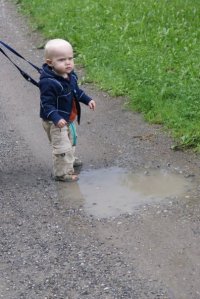
Kid1, on leash, walking by a river in Germany.
©PicklesINK 2013

It was the best option for both of us – Kid1 was free to explore without being stuck in the stroller or having his hand held (just take a minute to imagine how uncomfortable it must be to have someone much taller than you holding your hand up above your head until it falls asleep, gripping it hard enough that you can’t pull away) and I had the security of knowing that I could stop him if he suddenly bolted towards a hazard.

Ben with leash 3

And off leash!
©PicklesINK 2013

There are certain situations in which even the most anti-leash parent would be unlikely to argue that a safety harness isn’t a good idea:

Ben with harness on sailboat

On a sailboat with a lifejacket and safety harness.
©PicklesINK 2013

(For the record, the harness Kid1 is wearing in the preceding photograph is actually an adult boating harness intended for sailboat racing – safety devices ain’t just for toddlers, y’know.)

And how about in the case of special needs children? If you don’t think that’s appropriate, take a minute to walk a mile in some other parents’ shoes by reading the testimonials on this website from users of special needs child-to-adult harnesses. Or take it straight from the horse’s mouth, so to speak:

I’ve got the best harness in the world. When I first got it I didn’t like wearing it, but now I love my harness. I never get lost and I don’t have to keep holding hands all the time and its comfortable to wear. Big kids and little kids should wear a harness because you are never too old to be kept safe. And I love the colours.

– Tyler, Australia, Age 9, http://www.childharness.ca/testimonials.html

There are important guidelines to follow when using a toddler harness:

1. The whole idea is to give your child the freedom to explore on his or her own terms, so try to follow at his or her pace and guide your child with your words (“Time to go this way! Come on!”). Your child is not a puppy, and the harness is not an choke-chain, so do not jerk him or her back to you.

2. If you aren’t holding the harness, tuck it firmly out of the way, and take it off completely if your child is playing on something like a climber or slide where it could become a strangulation hazard.

3. When it comes to wrist straps, just don’t: If you can manage to get them tight enough to stay on, they’re just a broken wrist waiting to happen.

4. And of course, make sure that you come prepared with pithy rejoinders for those inevitable judgments, such as,

“Well, the breeder suggested that we try this first, but if his behaviour doesn’t improve soon, it’s off to obedience school!”

“Dear God! You’re right! This isn’t my dachshund Olympus – it’s my neighbour’s kid! I can’t believe I did it AGAIN!”

Or the classic, “You know what they say about people in glass houses.”

As Nadine Silverthorne points out, it is our job as parents to teach our children “the rules,” including the expectation that when we say “Freeze,” they will. I say that even more importantly, it is our job to know our own children and to keep them safe whether they are listening or not.  The call-and-response method that she describes is an excellent training tool, but at the toddler age it is simply not foolproof. There is always potential for distraction, and the use of a toddler leash can ensure that a moment’s  impulsiveness doesn’t turn into a life-altering tragedy.

~ karyn (aka that horrible, lazy, toddler-leash-using mom everybody love to judge!)

The Tao of Time-Out

The other morning I watched as a parent cornered one of Kid2’s teachers and asked, “So do you subscribe to that whole ‘time-out’ philosophy?” and she struggled to answer in a way that satisfied – not because one was wrong and the other was right, but because it often seems like when two people talk about “time-out” they might as well be speaking two completely different languages.

I don’t know when exactly “time-out” got such a bad rap, but I think a big part of the problem is that 99 percent of people who do “time-out” don’t do it right and 99 percent of people who don’t do it have only ever seen it done wrong. Most people who don’t believe in “that whole ‘time-out’ philosophy” have tried it out at some point – you know, the old,

“If you don’t stop that right now I’m putting you in time-out! DID YOU HEAR ME? That’s ONE! If I have to come over there, I’m going to…THAT’S TWO! I MEAN IT! DON’T MAKE ME GET TO THREE! I’m not kidding around! You are going in TIME-OUT, MISTER!! I TOLD YOU TO STOP! OKAY, THAT’S IT!! THREE!!! YOU GO AND SIT ON THAT TIME-OUT STEP RIGHT NOW!! You’re sitting there for five minutes because you didn’t…HEY, GET BACK ON THAT STEP! I TOLD YOU TO SIT DOWN! NOW THAT’S 10 MINUTES!! WHERE ARE YOU GOING? I THOUGHT I TOLD YOU TO SIT THERE!! NO TALKING!! DON’T MAKE FACES AT YOUR SISTER!! GET BACK ON THAT STEP RIGHT NOW! NOW YOU CAN SIT THERE FOR 10 MORE MINUTES!”

– and found that for some reason it didn’t work. We’ve all been there. The key to time-out is no different from any other discipline technique: Discipline techniques that work are those that are calm and consistent. Even spanking will be effective if it’s done within those parameters. I take issue philosophically with teaching children not to hit by hitting, but as long you consistently follow through, it will certainly change the behaviour that you want it to change.

???????????????????????????????

“THERE’S NO SMILING IN TIME-OUT, CHARLEY!!”
©PicklesINK 2013

1-2-3 Magic devotes an entire chapter to the false notion or “wish” (which I think is a really interesting way of looking at it) that is behind why most discipline attempts that don’t work: The Little Adult Assumption.

The Little Adult Assumption is the belief that kids have hearts of gold and that they are basically reasonable and unselfish. they’re just smaller versions of grownups, in other words. and because they are little adults, this notion goes, whenever the youngsters are misbehaving or not cooperating, the problem must be that they don’t have enough information at their disposal to be able to do the right thing.

Imagine, for example, that your eight-year-old son is torturing his little sister for the fifteenth time since they got home from school. What should you do? If your boy is a little adult, you simply sit him down, calmly look him in the eye, and explain to him the three golden reasons why he shouldn’t  tease his sister. First of all, teasing hurts her. Second, it makes you mad at him. Third — and most important — how would he feel if someone treated him like that?

Your son looks you in the eye, his face brightening with insight, and he says, “Gee, I never looked at it like that before!” Then he stops bothering his sister for the rest of his life. (1-2-3 Magic, pp. 15-16)

Even well into adolescence and young adulthood, our brains are still developing and changing. Children are simply not capable of understanding or thinking rationally at the same level as adults. Part of our job as parents is give your children a safe space in which to express their feelings and opinions, but another very important part of our job is to teach our children how to act appropriately  – “I understand that you are very angry, but it is not okay to throw your toys, and there are consequences to that choice.”

The parent talking to Kid2’s teacher said, “We do a lot of getting down to their level and talking to them.” 1-2-3 Magic explains that while one explanation can be appropriate – it could be that your child really did not have the necessary information to act appropriate – it’s attempts at repeated explanations that can lead to trouble, adding, interestingly, “too much parent talking irritates and distracts children” (p. 17). I can certainly see that – if I’m already feeling overwhelmed by a situation and consequently acting out, the last thing I need is for someone to get right in my face and talk at me! The teacher replied, “We use a lot of redirection, but then if we have to we remove the child from the situation.” Well, ladies and gentleman, in accepting this explanation that parent may not have realized it, but what that teacher described was…drum-roll please…a time-out!

I absolutely subscribe to “that whole ‘time-out’ philosophy.” It is one of the most important discipline tools I have as a parent. In a recent blog post, Alyson Schafer noted that the word “discipline” is derived from “disciple,” meaning to teach or guide. I see time-out as a tool for teaching as well as an important skill for my children to learn, and in fact part of that involves them seeing ME taking a time-out when I need to.

As I mentioned before, the two keys to effective discipline are consistency and calmness: Firstly, in order for any discipline technique to effect a change in behaviour, it must be consistent. This means that if you say, “If you don’t do/stop doing X, I am going to Y,” and the child doesn’t do/stop doing X, you HAVE TO do Y. If you don’t do Y EVERY SINGLE TIME, your child will actually not do/not stop doing X even MORE OFTEN than if you never did Y at all. In operant conditioning, this is called a variable-ratio reinforcement schedule. In fairness to anti-time-out parent, as long as he/she is consistently “getting down to his level and talking” EVERY SINGLE TIME it will also eventually work to change the child’s behaviour – the only danger is that if the child interprets this as positive attention, it is possible that the change may not be the one the parent intends.

Second, in order for any discipline technique to work the way you want it to, it must be calm. 1-2-3 Magic calls the use of too much (negative) emotion in trying to discipline a “parental temper tantrum.” When you let your emotions get the better of you while trying to discipline, several things happen: a. You show your child that he or she has the power to cause you to lose control; b. You upset and frighten your child; and c. You probably aren’t applying your chosen discipline technique consistently.

It’s the combination of parental loss of emotional control (temper tantrum) and lack of consistency that derails most attempts at “that whole time-out philosophy.” Remember that whole, “I’m telling you, IF I GET TO THREE YOU ARE GETTING A TIME-OUT, MISTER!!”?

My goal in using time-outs is to teach my children that there are times in life when you become overwhelmed by a situation or by your surroundings, and a way to deal with that instead of “having a freak-out” is to briefly step away from the situation, calm yourself down and gather your thoughts, and then return. At this age, most of time I have to tell them when that time has come – “Monkey, there is no yelling and throwing. You are going to sit out on the stair for 3 minutes because you yelled and threw your toys,” or “Bud, you need to calm down. You can go and take a time out in your room and look at books until you’re ready to stop yelling and whining,” – but my hope is that they start to recognize these times for themselves.

Just think how much simpler life would be if it were socially acceptable for us adults to say, “Could you excuse me? I’m going to take a moment to gather my thoughts.”

~ karyn