Archives

Who’s really sexualizing our daughters, anyway?

The fabulous Stephanie Giese of Binkies and Briefcases wrote a viral post about her disbelief at the sizing and coverage in Target’s clothing options for young girls. She had been noticing what seemed to be a distinct reluctance to include…y’know…fabric…in items like shorts for girls as young as 5. Her post received a mostly positive response, but also a fair bit of backlash (One standout was a commenter who posited that she should put her “fat-ass kid” on a diet if she wanted clothes to fit her better. Way to keep it classy, interweb.).

Quite impressively, Target reacted almost immediately, reaching out to her, doing their own research, and promising an overhaul of their sizing practices including feedback from “real” moms like her, which is awesome – we should be able to find clothing for our children that fit with our own tastes and values without having to pull out our sewing machines and make or modify them ourselves.

But…(you know me…there’s got to be a but)…I don’t agree with the reasoning that we need more modest clothing options to avoid sexualizing our young daughters. Children are not sexual. Exposed skin is not sexual. Children with exposed skin are not sexual.

Children are children. Continue reading

Why a newspaper “Ethics” columnist thinks 7 year-olds in competitive dance are akin to sex workers.

Good news, everyone! I’ve decided to feature an occasional anonymous feminist advice column. Please feel free to send along your submissions and tell your friends!

Dear Sylvia,

I just read this article in an online newspaper, and it left me deeply troubled. It called itself an “ethics column” but really seemed much more like a “patriarchy judge-o-matic.”

A concerned party wrote in with a question about a 7 year-old girl involved in competitive dance; apparently this person’s colleague showed him/her a photo of the colleague’s daughter in dance competition costume. Rather than respond with a socially acceptable, “That’s nice,” the letter-writer, judging that in his/her opinion, the girl in the photo was made up to look like a sex-worker, said something along the lines of, “Hey, I don’t know much about you or your family, but based on this single picture of your daughter about which you were obviously excited enough to show me, a work colleague whom you clearly don’t know all that well or you might have expected such a tirade, but I feel that your parenting skills are inadequate, your judgement is lacking, and if left unchecked, your daughter will probably grow up to be a whore. You should be ashamed.” Continue reading

Yes, Virginia, feminists do wear miniskirts.

When I was in high school, I was the goodiest of all two-shoes. My marks were in the high 80-90s across the board. I sang in 3 choirs, if you count the children’s church choir I assistant-directed. I played 2 instruments in 3 orchestras, including my school’s professional double quartet. And by professional I mean we played actual paid gigs; the school hired us out to play functions on our own time, earning $500 a pop which went straight into the school’s bank account. But, y’know…happy to oblige, right?

I didn’t go to parties. I didn’t drink. I didn’t smoke. I didn’t even know what a mary-ju-wanny cigarette looked like, and I didn’t even round first base until I was in university.

When you consider the external pressure of a high-achieving family and an expensive private school education, combined with the internal pressure of a type A perfectionist personality, something’s bound to give, right? On top of that, there were a lot of shitty things going on at my school, some that I was just witness to and others that impacted me personally, and there comes a point when you have to do something to push back.

I directed the majority of my aggression internally, as many of your teenage girls do, but I had one small form of outward rebellion – just one. Every morning I woke up and put on a dark-coloured brassiere before I buttoned up my white oxford shirt. It was my way of subtly flipping off the entire institution. I was well aware that my snazzy undergarments were visible through my uniform shirt, and I loved it.

I wasn’t the only one. There were hundreds of us with our little micro-rebellions – rolled up kilts and rolled down socks; hiding friendship bracelets under our shirtsleeves and concealing polished fingernails in our fists. One student wore a band-aid over a nose piercing for months, ripping it off every day at 3:45 and letting her silver ring breath free. We weren’t trying to impress any boys. There weren’t any boys to impress, unless you count the maintenance guys we used to bum cigarettes from or that computer tech who offered to split a joint with me at a club.

It seemed fitting – the ways that they were screwing me over were well within their framework of rules and policies, and so was this. Trust me. I checked.

By all accounts though, my choice of attire was “unprofessional.” Shouldn’t the school have put a stop to this? Isn’t it their job to teach me to maintain proper decorum? How would I one day find gainful employment if I didn’t even understand how to dress the part?

The thing is – I did understand. Completely. I understood that school was not, in fact, a job. I understood that school was a place where I was expected to study and learn so I could get good marks and go to a good university. I understood that school was a place where I was expected to treat my teachers and fellow students with respect. School may have been a lot of things, but a job it was not; a job, you see, pays you money.

Of course, it being a private school, I also understood that I was required to follow certain standards of dress and accessorizing (uh…none), so I wore all of the uniform pieces that were required of me. I carefully noted, however, the lack of supportive undergarment-related parameters in my school’s Code of Conduct – Uniform Policy, and smiled to myself as I hooked together my navy and white gingham bra.

I also understood jobs. My job at the time was babysitting, of which I did rather a lot, and for that endeavor, I dressed differently – appropriately, one might say, if by appropriately one meant, “Wearing stuff that wouldn’t be damaged while playing with children and was easily laundered.” Obviously, this ruled out my uniform since that blinking kilt had to be ironed within an inch of its life. Word to the wise – if you’re choosing a private school for your daughter, the wider the pleats, the easier the care.

And interestingly enough, I figured all this out by myself. My school didn’t educate me in how to dress appropriately for babysitting. Or for being an auto mechanic. Or a flight attendant. Or a swimming instructor. Or a lawyer. Or a professional beach volleyball player. When I hear people say that students need to dress appropriately at school to prepare them for the standards of dress they will encounter in their workplace, I always wonder, “What kind of workplace?”

At school we sit at a desk and write stuff and sometimes we use computers, so I guess we equate it with an office job and impose or encourage standards similar to what you would find in that environment. But if school is supposed to prepare students for entry into the workforce, why can’t we think outside the cubicle?

Or is it less about clothes and more about teaching students that in the workplace they will be expected to follow instructions, including but not limited to standards of dress. I guess that makes a little more sense, but aren’t there enough rules for them to follow already before clothing even enters into it?

All right – let’s accept for the moment that it *is* the education system’s job to prepare students for the workforce, and that setting and enforcing clear dress codes are one way to do that.  The next issue that we arrive at is the fact that school dress codes are inherently discriminatory, disproportionately singling out women and girls.

With the help of my friend Google, I’ve had a look at some school dress codes in Ontario – elementary and secondary schools in both the public and Catholic boards, and here is what I’ve come up with:

We are fortunate that school dress codes contain helpful, concrete descriptions that can in no way be misconstrued, like “modest,” “respectful,” “respectable,” “inoffensive,” “non-distracting,” “neat,” “appropriate,” “proper,” and “decorous.” Clothing should not, on the other hand, be “distasteful,” “revealing,” “distracting,” “offensive,” or “sexually provocative.”

Well, that should be easy to figure out and to follow, right? No margin for error there! On the off chance that you do have difficulty interpreting the guidelines (or *cough cough* happened to stumble upon a loophole), they often include helpful summary sentences like these:

“All clothes are to be appropriate for the learning environment as deemed so by the staff at the school.”

The Administration reserves the right to decide on appropriate attire.”

Perfect! No matter how iron-clad the rules are, there’s a leetle space for wiggle room in the form of arbitrary judgement.

This one actually acknowledges that different attire is suited to different settings:

“Clothing that may be appropriate at home, at the beach, or at a nightclub may not be appropriate at school.”

Unfortunately, that sentence is preceded by this one:

“All members of the school community must dress in a way consistent with a scholarly tone: dress that reflects personal pride and respect for others.”

A scholarly tone? I’m not sure what that means. Can you elaborate? “Members of the school community are required to be adequately covered to be consistent with a scholarly school tone.”

Scholarly tone = adequately covered = reflecting personal pride and respect for others.

Gotcha. I do apologize to anyone my bare shoulders ever disrespected. Totally my bad.

Not wanting to leave anything up to chance, it gets even more specific: No clothing or accessories which “are unduly distracting, including but not limited to, dress which is sexually provocative, torn or ragged.”

Ah, there’s the rub, right there in black and white:

Sexually provocative = unduly distracting.

This one includes a rationale . Apparently, the dress code contributes

  • to a safer and more secure school policy;
  • to the development of an educational learning environment;

I had no idea that modest dress was safer and more educational. You learn something new every day. Oh, but wait…Something’s coming back to me…Now that I think about it, I do recall hearing something about that back in “How Not To Get Raped 101,” otherwise known as a day in the life of a girl in rape culture.

That very same school concludes with a catchy little slogan just to drive the point home: “Remember: If we can see up it, down it, or through it, then it shouldn’t be worn at school!”

But I’m sure that’s directed at both genders equally…

I’m happy to report that my school took my rebellion in stride. While I happen to know that there were several changes made to the uniform policy after I left, it was never addressed with me, aside from the one teacher who, her clipped English accent dripping with sarcasm, “That’s a very nice checked brarr, Kahryn.”

The lack of reaction was a surprisingly feminist response. They had certainly come a long way from the lines of girls kneeling in the hallways to face the yardstick kilt-measure of my middle school years, and even farther from the “line up and bend over,” bloomer-checks that were rumoured to have been conducted not long before my time.

Why am I telling you all this?

I’m telling you this because it is important to understand that there is a person in those short-shorts or wearing those visible bra-straps, and she doesn’t necessarily lack self-respect or an understanding of appropriate attire.

She may have a stable father figure, or she may not. Her parents probably raised her just fine, or maybe they didn’t, but her clothes don’t tell you anything about that.

She’s not “asking for it.”

She’s not necessarily wearing the only thing she can afford, or she might be, and she might have chosen to wear it anyway, or maybe she wishes she had something different.

She’s not doing it because she enjoys the attention from most of the boys and some of the girls. Or she might be, and that’s her business too. Me, I enjoy attention, so I dye my hair purple, because sadly, the attention I get for showing parts of my body is not what it used to be – “Mommy!! Your breastses are HANGING DOWN!!”

She’s not showing disrespect to her teachers or to her classroom, because how is showing her own skin, or a half-inch wide strip of elasticized fabric, being disrespectful, unless of course we are operating on the premise that a woman’s body or undergarments are somehow offensive?

She’s Just. Wearing. Clothes.

And maybe if we stopped getting our granny panties in a knot about it we could get on with dealing with the far more serious things that teenagers today are dealing with.

Like Bullying.

Mental illness.

Substance use.

Rape and sexual assault.

Academic disengagement.

Unemployment and underemployment.

Perhaps our outrage and our measuring tapes could be put to better use.

 ~ karyn
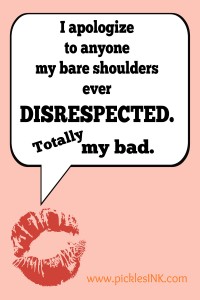
Maybe it's time to reconsider school dress codes - or at least consider why we have them.

I apologize to anyone my bare shoulders ever disrespected. Totally my bad.
Not your mama’s toy shopping tips

‘Tis the season!! As the ground turns snowy and swathes of red and green appear in the dollar store, our thoughts turn to the joyous season of giving.

Christmas store

Dollar Store in October. No joke.

To help you with that giving, I have been carefully poring over toy catalogues to compile a list of my top 10 essential Christmas shopping tips. I really hope that you find them helpful!

Ben santa

10 Essential Toy Shopping Tips, straight from Santa!

Top 10 Christmas Shopping Tips

(according to a national retail toy catalogue)

Tip #1:

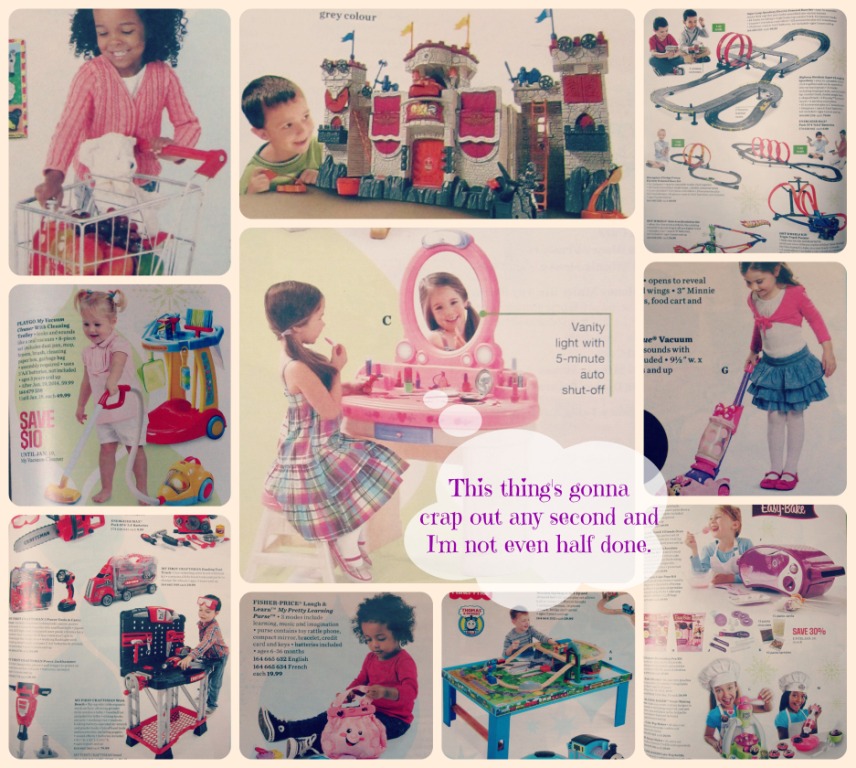
For the little boy in your life, pirate, castle, race car, tool kit and train play sets are always appropriate choices. Don’t accidentally buy one for your little girl, though. She would much rather have a pretty pink purse, baking set, realistic shopping cart, or vanity unit with light – the 5-minute auto shut-off means she won’t get into the habit of primping for too long, and her future husband will appreciate that, amiright? Pair that with her very own vacuum cleaner and cleaning trolley and look at her go!

Graphic for Number 1

Collage of catalogue pages. Thought bubble reads, “This thing’s gonna crap out any second and I’m not even half done.”

Tip #2:

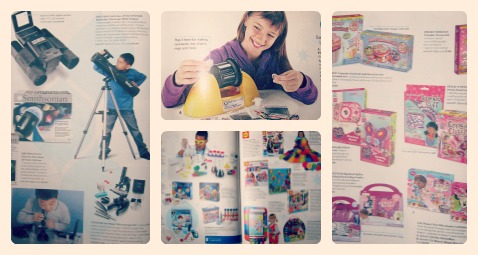
Boys love science, so look for a telescope, chemistry set, microscope, or any of many other assorted science kits with only boys on the boxes. As I’m sure you realize, girls aren’t really good at that sort of thing but they do like to make pretty stuff, so you could try the rock-tumbling kit; maybe she’ll even learn something while creating earrings, necklaces, or keychains! For even more creativity without the distracting science focus, consider any of a wide variety of craft kits.

Graphic for Number 2

Collage of catalogue pages

Tip#3:

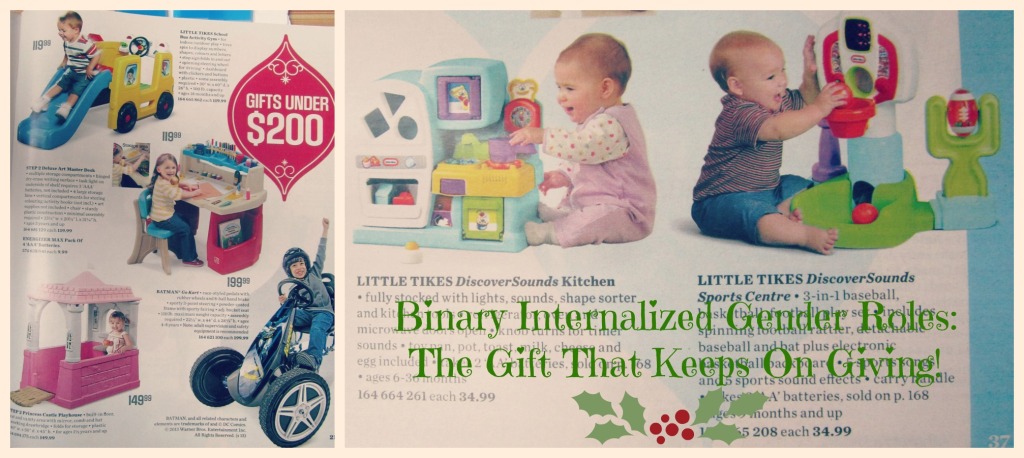
Looking for something a bit bigger? Little girls really like to sit and draw, or even just sit passively and look pretty, so consider a art desk or a pink princess castle playhouse for her. For her brother, how about an activity gym or superhero-themed real go-kart? Those boys really like to get active while their sisters watch! Remember, they’re never too young to start internalizing appropriate gender roles, so consider an infant-sized kitchen play-set for Baby Susie or sports centre for Little Johnny.

Graphic for Number 3

Collage of catalogue pages. Text reads, “Binary Internalized Gender Roles: The Gift That Keeps On Giving!”

Tip #4:

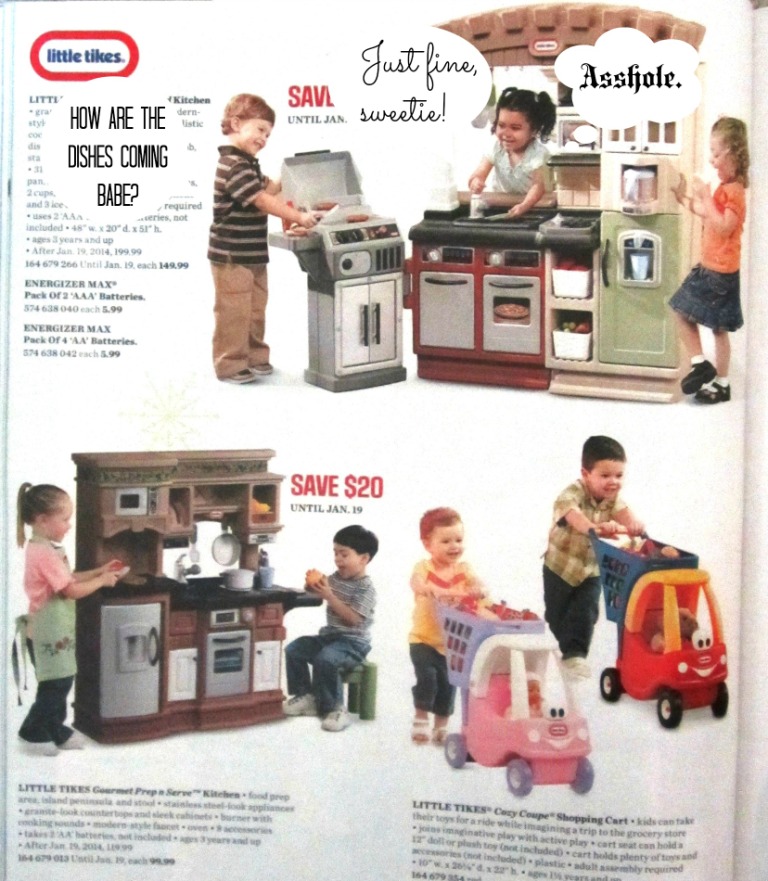
For toddlers and preschoolers, you can’t go wrong with a classic child-sized kitchen play set. It used to be that these were only for the little girl in your life, but we’ve come a long way, baby! Now you can get realistic-looking toy kitchens so that boys and girls can play together – think how much fun your kids will have reinforcing gender stereotypes when she washes dishes while he barbecues, or even better, as she fixes him another sammich while he scarfs down the first!

Graphic for Number 4

Catalogue page. Speech and thought bubbles read: “How are the dishes coming babe?” “Just fine, sweetie!” “Asshole.”

Tip #5:

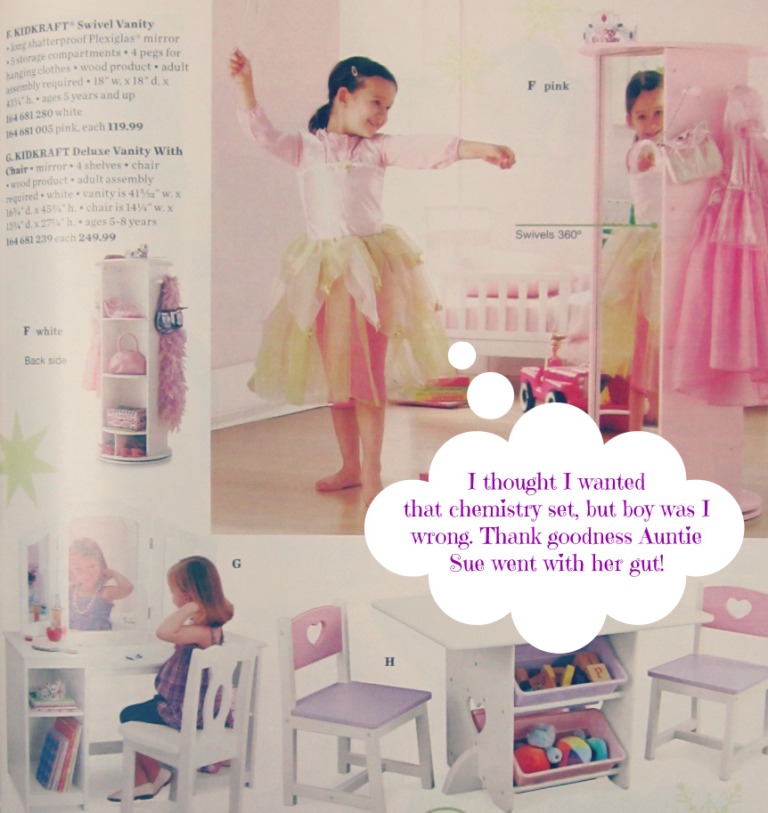
Little girls love to play dress-up and then look at themselves in the mirror, so the only question is: Table-top or full length? (Or how about both?)

Graphic for Number 5

Catalogue page. Thought bubble reads, “I thought I wanted that chemistry set, but boy was I wrong. Thank goodness Auntie Sue went with her gut!”

Tip #6:

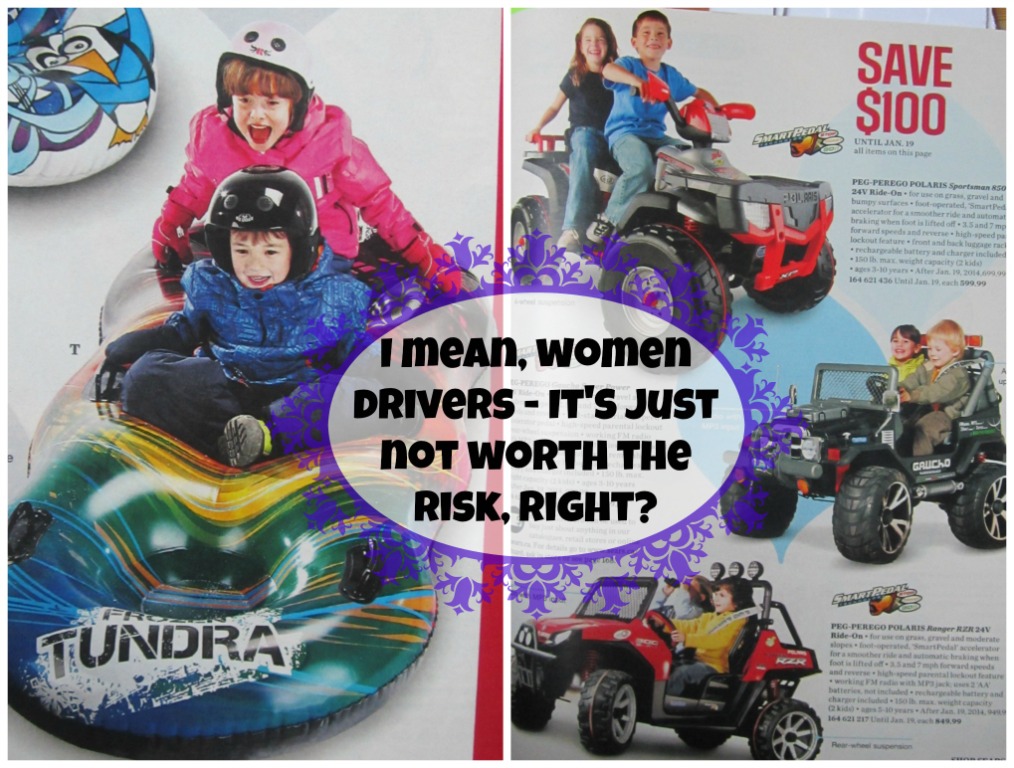
Outdoor toys like sleds, battery-operated cars and other ride-ons are always a hit! If you want your daughter to participate make sure she has a brother or little boy friend who can take the controls because you know what they say about women drivers…

Graphic for Number 6

Collage of catalogue pages. Text reads: “I mean, women drivers – It’s just not worth the risk, right?”

Tip #7:

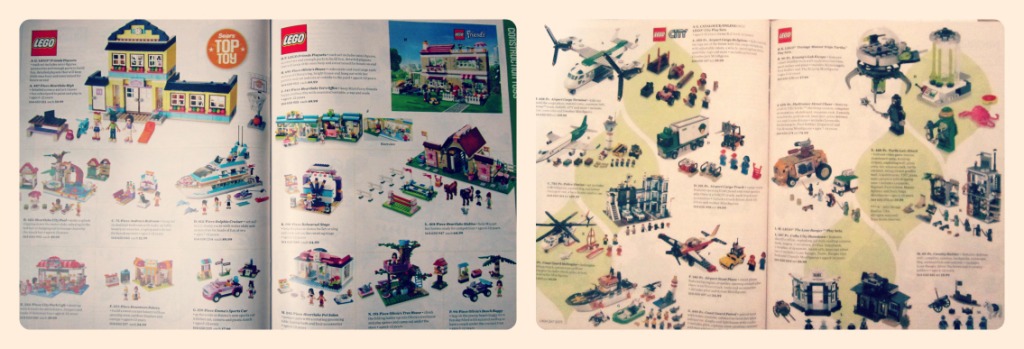
Building sets are also an excellent choice for both boys and girls. The manufacturer makes it easy for the consumer to ascertain which sets are appropriate for boys or girls by selectively gendering the character figures that are included. Your daughters will love building the sets and then grooming horses, pampering pets, hosting sleepovers, or running a bakery with Andrea, Emma, Stephanie, Mia, and Olivia, while your sons will enjoy flying planes, fighting bad guys, and performing open water rescues while identifying with male pilots, lumberjacks, forklift operators, police officers, superheroes, and coast guard members!

Graphic for Number 7

Collage of catalogue pages

Tip #8:

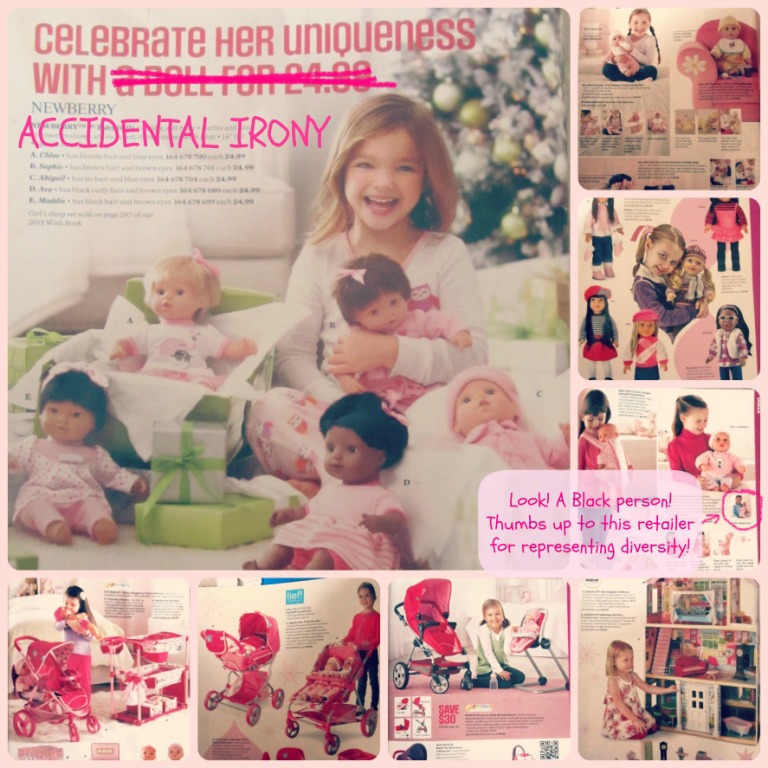
What little girl wouldn’t love a baby doll to cuddle and care for or a little girl doll to be her best friend? With a wide variety of doll furniture and other accessories available in a vast array of shades of pink, your little mommy can dress, change, bath, and feed her little baby to her heart’s content. Since statistics show that the vast majority of little girls are white or just slightly tanned, you will easily be able to find a doll that your daughter can relate to. As the catalogue suggests, “Celebrate her uniqueness” with the gift of unintentional irony! Playing with dolls develops nurturing, caring, and empathy, which is wonderful for girls, but of course we don’t wish to encourage those traits in boys, which brings us to our next tip –

Graphic for Number 8

Collage of catalogue pages – in fact, EVERY SINGLE page in the doll section. Text reads: “CELEBRATE HER UNIQUENESS WITH ACCIDENTAL IRONY” and (pointing to tiny inset photo) “Look! A Black person! Thumbs up to this retailer for representing diversity!”

Tip #9:

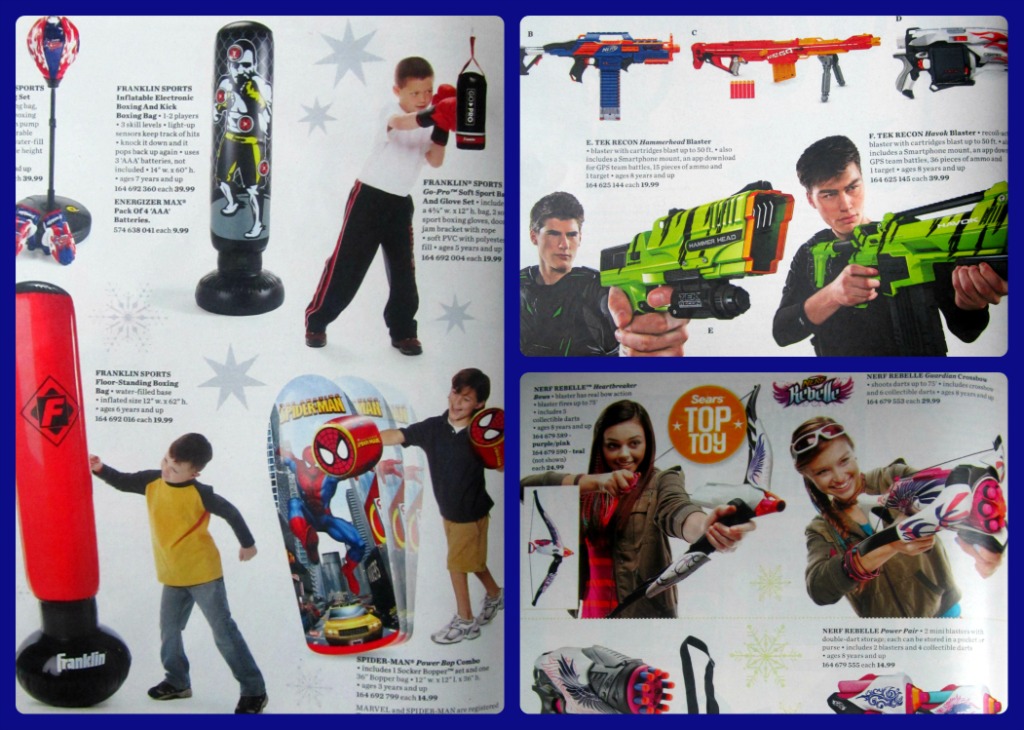
Boys love violence! Luckily there is a wide variety of toys available to feed those urges, including boxing sets, guns, and ammo. For your little Katniss, consider a pink/purple gun, bow, or crossbow – and so you don’t have to say it, the little “Rebelle” logo will remind her every time she sees it that it’s not quite socially appropriate, now, is it?

Graphic for Number 9

Collage of catalogue pages

Tip #10:

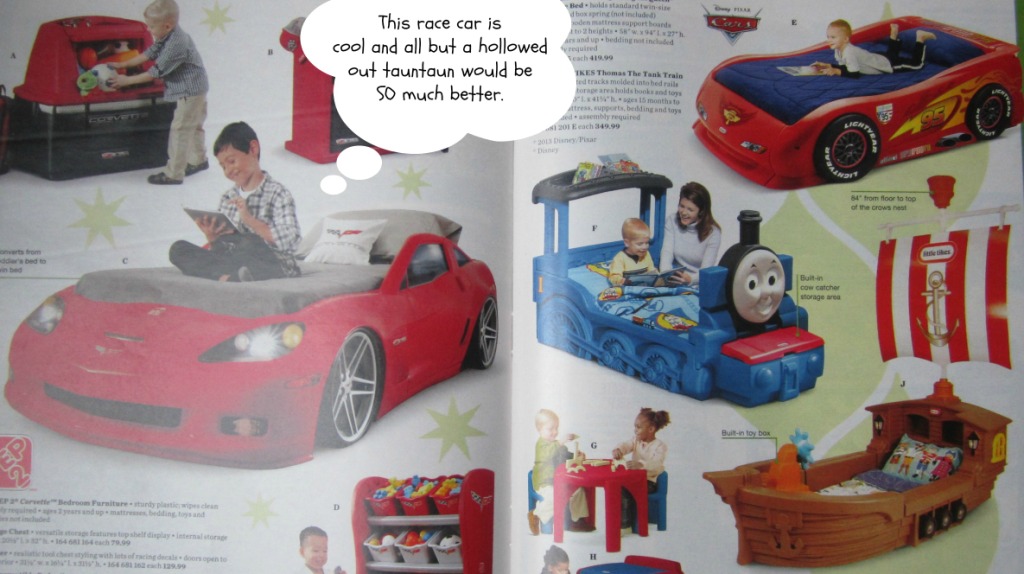
Finally, if toys aren’t really your game, consider furniture. Is your little one outgrowing his crib? Why not get him an awesome toddler bed that looks like a sports car, train, or pirate ship? If you have a daughter, you’ll have to think of something else since a hollowed out fairy princess would be kind of creepy. (Aside – How is it that no-one has made a disemboweled tauntaun toddler bed yet?? Mattel? Little Tikes? This is cross-branding GOLD. You guys will definitely want to get on that. I expect a 10% royalty on every unit sold.)

Graphic for Number 10

Catalogue pages. Thought bubble reads, “This race car is cool and all but a hollowed out tauntaun would be SO much better.”

Special bonus tip #11:

Be aware of the way that toy marketing influences as well as reinforces gender roles. Don’t buy into the marketing gimmick that tells you that you have to go to the separate “girls” section to get a pinkified version of the same familiar toys. Companies aren’t doing it because research has shown that there is a qualitative difference between “boy” stuff and “girl” stuff. They’re doing it because they know they can get you to spend your money twice on the same damn thing.

Listen to your children. Let them develop their own likes and dislikes – don’t let the toy companies do it for them. If your daughter asks Santa for a 44-piece tool kit while your son wants an Easy-Bake oven, congratulate yourself on doing parenting right. (I still use that tool kit – thanks again, Santa!).

The social construction of gender is a cyclical process – advertising doesn’t create those constructs, but it doesn’t try to undermine them either, because retailers make money by giving us what we want to see: Little white girls playing with dolls and boys driving racecars. They think that we won’t be as likely to buy it if they catch us off-guard with something that doesn’t seem quite right, so they (and we) continue to force our hockey-playing girls and our Strawberry Shortcake-loving boys back into those boxes that society has built for them over and over until eventually they decide that they might as well just stay there.

Let kids be kids, not gender constructs. The next time you see a toy catalogue with 9 pages of little (white) girls playing with doll stuff and not a boy in sight, take a cue from Kid1 and shout it out, loud and proud:

“That’s a STEREOTYPE!!”

Collage of photos of boys and girls being themselves

Collage of photos of boys and girls being themselves

Please Note: This is not a sponsored post. All artwork, unless otherwise noted, remains the property of the original photographer. My observations are based on my analysis of trends seen in toy catalogues and do not refer to any specific retailer or manufacturer pictured.

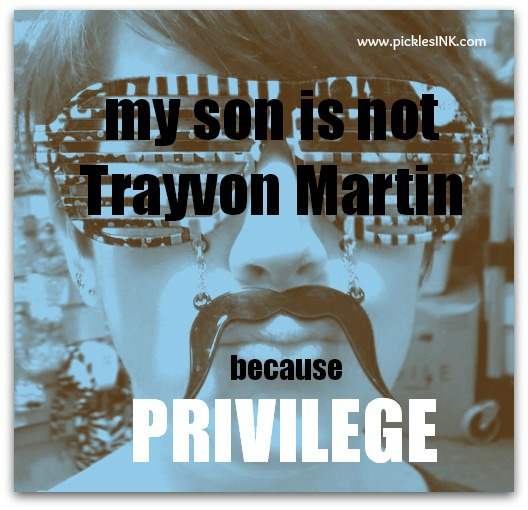
My sons are not Trayvon Martin

I’m going to take one of my rare serious turns for a moment:

I am not Trayvon Martin’s mother.

Ian is not Trayvon Martin’s father.

And my sons will never be Trayvon Martin.

My kids will never know the feeling of being looked on with suspicion as they walk down the road at night (or any time).

I will never worry, when wondering why Ian isn’t home yet, that he has been stopped without cause and shot by police while reaching for his license.

Unlike actor/director of Roots and ST:TNG fame LeVar Burton, we won’t have to teach our kids the fundamentals of how to avoid being killed by police when stopped for the offense of driving while black:

Listen, I’m gonna be honest with you, and this is a practice that I engage in every time I am stopped by law enforcement, and I taught this to my son who is now 33 as part of my duty as a father to ensure that he knows the kind of world in which he is growing up. So when I get stopped by the police, I take my hat off and my sunglasses off, I put them on the passengers’ side, I roll down my window, I take my hands, I stick them outside the window and on the door of the drivers’ side because I want that officer to be as relaxed as he can be as he approaches my vehicle. And I do that because I live in America.

                                                                              – LeVar Burton, 2013

We will never have to worry about them being shot by a stranger, not because they were in the wrong place at the wrong time, but because they were in a place they had every right to be, at a time they had every right to be there, but were born with the wrong colour skin to be able to safely assert those rights.

And if, God forbid, and I’m having trouble even typing this out, one of my children ever was murdered, it wouldn’t even cross my mind that the person responsible would walk free, smiling smugly, his or her supporters celebrating with fireworks displays, with the story of the verdict relegated to a tiny square below the (virtual) fold while the lead news story bemoans the untimely death of a troubled young (white) TV star.

Because we are white, we don’t live those realities. Our reality is very different. Heck, if I decided to steal a bike and freely admitted to it when questioned, people would probably offer to help me do it.

So what I am going to do about it?

I’m going to name my privilege. I’m not going to hide behind, “But I’m not a racist,” because that’s not good enough. The world I live in is oppressive, and I benefit while others are oppressed, and if I don’t recognize that and call it out, I am complicit.

I am not going to teach my kids colourblindness, because that’s not good enough either. They need to know that actually, we’re not all the same regardless of the colour of our skin. The way we are treated by the world is different because of the colour of our skin, and that is not okay.

I’m going to name privilege and oppression where and when I see them, and teach my children to do the same, because although it may make me uncomfortable, it’s nothing compared to what Trayvon Martin’s mother and father had to do.

~ karyn

Here are some resources for talking to your children about race:

How do you talk to kids about race? This guide can help.

RACE: The Power of an Illusion (PBS)

My son is not Trayvon